The 50/30/20 Method: How to Organize Your Personal Budget in Practice
Organizing your personal budget becomes much simpler when you have a clear starting point.

Organizing your personal budget becomes much simpler when you have a clear starting point. The 50/30/20 method proposes dividing your monthly net income into three parts: 50% for essential needs, 30% for wants, and 20% for financial goals, such as saving, investing, or paying off debt. In this article, you'll see how to carry out this division step by step, with a hypothetical numerical example, and how to adapt the percentages when your reality doesn't allow you to follow the original split.
Important: the 50/30/20 method is an educational budgeting heuristic. It is not a law, a regulatory rule, or a universal investment recommendation. The numerical examples are hypothetical and do not constitute investment advice or any promise of returns.
What is the 50/30/20 method
The 50/30/20 method is a simplified personal budget management model that proposes dividing monthly net income into three parts:
- 50% — needs: essential expenses, such as housing, electricity and water bills, groceries, transportation, and healthcare;
- 30% — wants: non-essential lifestyle expenses, such as food delivery, streaming, entertainment, and impulse purchases;
- 20% — financial goals: saving, investing, or paying off debt.
One essential point: the percentages apply to your net income (what's left after deductions, such as payroll taxes and income tax), not your gross income. If you'd like to go deeper into organizing your household finances overall, the article on family budgeting covers the complete picture; here, the focus is on the practical execution of the 50/30/20 split.
How to classify each expense: the essentiality criterion

The most common question when applying the method is deciding what counts as a "need" and what counts as a "want." A practical criterion is essentiality: if you could go without that item or service for a month without serious damage to your basic routine, it probably belongs in the 30% (wants) category.
Some classification examples:
| Expense | Category | Why |
|---|---|---|
| Rent | Need (50%) | Without housing, your basic routine is compromised |
| Groceries | Need (50%) | Food is essential |
| Commuting to work | Need (50%) | It sustains your income generation |
| Streaming | Want (30%) | You can go a month without it |
| Food delivery | Want (30%) | Essential food is already covered by groceries |
| Gym | It depends | If it's a health requirement, it tends to be a need; if it's leisure, it's a want |
| Everyday clothing | Need (50%) | Basic clothing is essential |
| Fashion/seasonal clothing | Want (30%) | It doesn't compromise your basic routine |
There are ambiguous categories — gym, clothing, cell phone plans — that can vary depending on your routine. What matters is applying a consistent criterion and recording your decision, so your budget stays comparable month to month.
Step by step to execute the split
- Calculate your monthly net income. Add up everything that actually lands in your account after deductions. If your income varies (self-employed, freelancer), use an average of recent months so you don't build your budget on the best-case scenario.
- List all your expenses for the month. Use your bank statement, credit card bill, and receipts. The walkthrough on reviewing your bank statement helps with this step.
- Classify each expense as a need, want, or goal, using the essentiality criterion.
- Compare against the target percentages. Multiply your net income by 0.50, 0.30, and 0.20 and see where you're above or below.
- Adjust. If your wants exceed the 30%, cut there before touching your needs. If your needs exceed 50%, see the adaptation section below.
Hypothetical example: net income of R$ 3,200
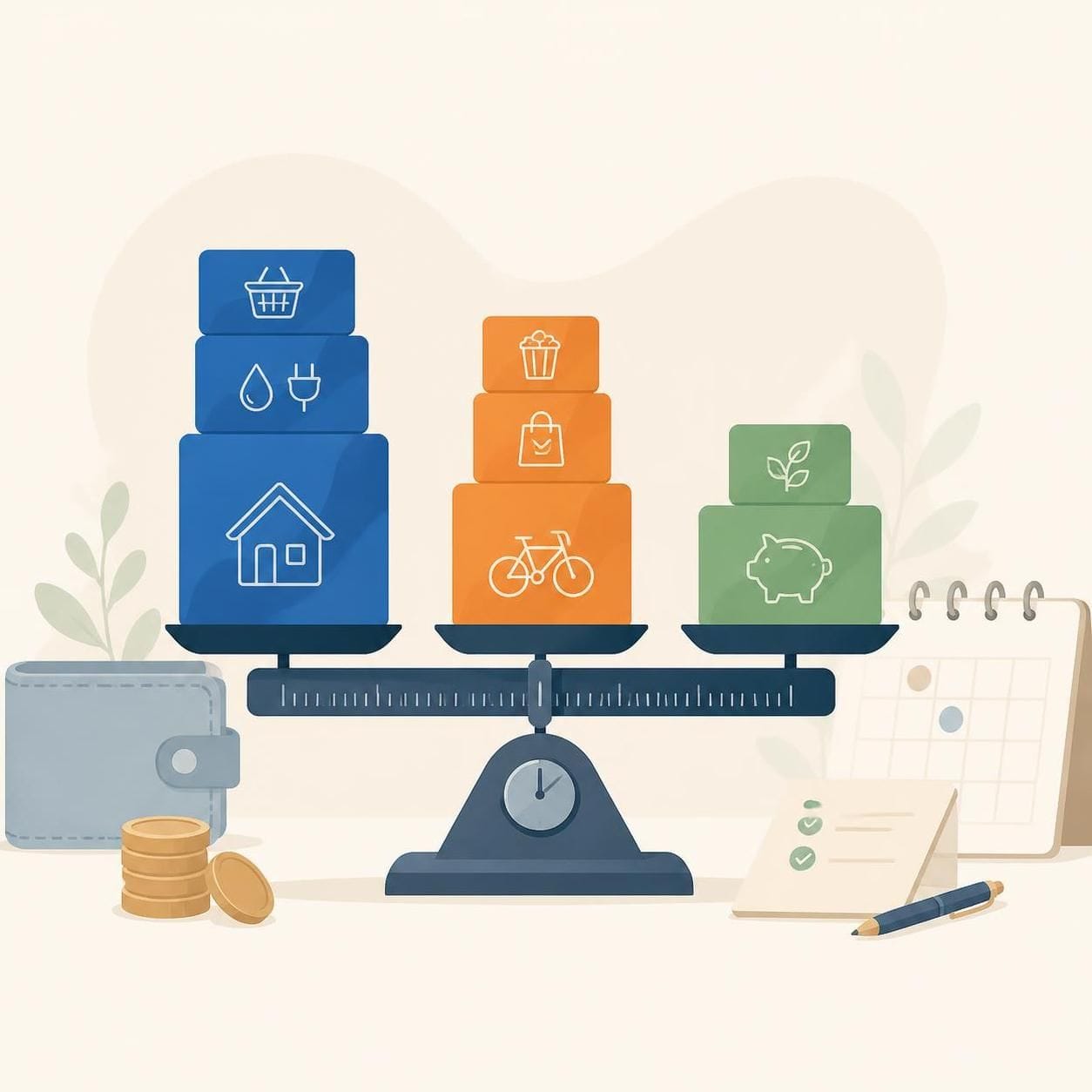
Suppose someone with a net income of R$ 3,200 per month. Applying the original split:
| Category | Percentage | Amount (R$) | Example expenses |
|---|---|---|---|
| Needs | 50% | 1,600 | Rent, bills, groceries, transportation, healthcare |
| Wants | 30% | 960 | Delivery, streaming, entertainment, non-essential purchases |
| Financial goals | 20% | 640 | Emergency fund, investing, debt payoff |
This is a hypothetical example, created solely to illustrate the calculation. It does not constitute investment advice or any promise of returns. If the 20% is meant to start an emergency fund, the article on how much to save in an emergency fund helps you set a target amount; and if the priority is to start investing, the guide on how to start investing shows the first steps.
When the 50% doesn't fit: adapting for low incomes
Here is the method's most important limitation: for low incomes, or situations with dependents or high debt, essential expenses can exceed 50% of income. In that case, forcing the original split only leads to frustration — the method doesn't account for very different contexts, such as families with dependents, high debt, or insufficient income.
The recommended path is to adapt the percentages instead of abandoning the budget. One alternative cited by Serasa is the 70-20-10 split (70% needs, 20% wants, 10% goals). The principle remains the same: separate essentials from non-essentials and set aside some portion — however small — for financial goals. Saving a little is still better than saving nothing, and the article on how to invest 100 reais per month shows that the starting amount matters less than consistency.
If debt is the problem, the priority for the 20% (or the adapted portion) tends to be paying it off; the guide on how to get out of debt on a low income details that strategy.
Common mistakes when applying 50/30/20
- Calculating on gross income. The percentages apply to net income; using gross income inflates your budget.
- Treating the method as a rigid rule. Personal finance reference sources, such as Serasa and Exame, treat the split as a starting guide to be adapted, not a mandatory standard.
- Classifying wants as needs. If you can go without the item for a month without serious harm, it tends to be a want.
- Ignoring atypical months. Seasonal expenses, such as vehicle taxes, gifts, and vacations, distort the split; the article on seasonal expenses shows how to set money aside for them.
- Giving up on the first attempt. The first month serves as a diagnosis; the adjustments come after.
FAQ
Is the 50/30/20 method an official rule? No. It's an educational budgeting heuristic, popularized as a reference in the US. It is not a law, a regulatory rule, or a universal investment recommendation.
Does it work for people with low incomes? It may not fit. For low incomes, with dependents or high debt, essential expenses often exceed 50% of income. In that case, adapt the percentages (for example, 70-20-10) instead of forcing the original split.
Can the 20% be used to pay off debt? Yes. The financial goals category includes saving, investing, or paying off debt — prioritizing debt usually makes sense when interest rates are high.
How is this different from a household budget? A household budget covers the complete organization of a household's finances, with all income and expenses. The 50/30/20 is a specific technique for dividing net income into three blocks — a tool within the budget, not a replacement for it.
Do I need to follow exactly 50%, 30%, and 20%? No. The percentages are a starting point and should be adjusted to your financial reality.
Conclusion
The 50/30/20 method is useful because it provides a simple, scannable starting point: half of your net income for essentials, 30% for what you enjoy, and 20% for your future. The real value, however, lies in adapting it: use the essentiality criterion to classify expenses, calculate on net income, and adjust the percentages when needs exceed 50% — which is common with low incomes or dependents. Start with one diagnostic month, compare against the percentages (original or adapted), and review the split periodically. Budgeting is a process, not a fixed formula.
This content is educational and does not constitute individual investment advice.